

When I started using Slack professionally, I noticed how much of my day went into deciding what to ignore.
Communication had become a full-time background process. Slack messages, threads, reactions, email, shared documents and Zoom meetings all made it easier to reach people. They also created more places to check, more conversations to follow and more decisions arriving throughout the day.
It sometimes felt like working in an office where, every ten minutes, someone stood up and shouted something to everyone else. Each interruption might be useful to someone. Everyone else still had to spend a little attention deciding whether it mattered to them.
Generative AI did not create that noise. It industrialized it.
Over the past two years, the cost of producing a plausible message, document, presentation or piece of code has collapsed. Now add agents that can process information and generate new artifacts while nobody is watching. Every person can produce more, every team can ask for more, and every system can report more.
Our capacity to pay attention has not changed at all. Herbert Simon saw the shape of this in 1971: a wealth of information creates a poverty of attention.
From signal-to-noise to noise-to-value#
We usually describe this as a signal-to-noise problem. That misses something important.
A message can be relevant, well written, addressed to me and still have no value. A document can be accurate and polished without changing a decision. Code can work and still be the wrong thing to add to a product.
Signal is what appears relevant. Value is what changes what I understand, decide or do.
Those used to be closer together. Writing a thoughtful document took time, so the effort behind it was at least some evidence that it mattered. That filter was never perfect, but it existed. Today, producing something polished can take one prompt. It might contain real value, or none at all. The appearance of effort no longer tells me much about the value underneath it.
So the measure I care about is a noise-to-value ratio: how much a person has to get through for each thing that changes what they understand, decide or do. AI raises the first number for free. The second depends on human judgment, which has not sped up.
The bottleneck has moved from production to consumption. We can generate more than anyone can responsibly review.
Two ways to lower the ratio#
One answer is to slow down. No team that wants to stay competitive will.
The other is to work on both sides of the ratio: get better at finding the value in what reaches me, and be intentional about what I add for everyone else.
Both matter most where people decide together what to build, how to approach it and why. Those decisions rest on things a model does not have. It has never been annoyed by a UI. If that conversation fills with generated material, the human voices in it get harder to hear, and they are the reason the conversation exists.
Fine is harder to filter than bad#
The difficult material is not obviously broken. Spam is easy to reject. A bad document announces itself. Much of the new output is fine: coherent, relevant enough and professionally formatted.
Fine work still consumes attention. Someone has to read the document, review the pull request, check the summary or decide whether the recommendation matters. The production cost disappeared, but the review cost moved to somebody else. Researchers writing in Harvard Business Review gave this a name, workslop: AI-generated work that looks finished and leaves the real effort to whoever receives it.
I see the same effect with my own agents. A status update can be correct and still tell me nothing I need to know. A completed task can create another document to review. A notification intended to prove useful work happened can become more work itself.
The usual failure is quieter than drowning: skimming everything, switching context constantly and giving nothing the attention it deserves.
As a reader: protect attention, then let AI order it#
I start with something that has nothing to do with AI. I block time for deep work. Anything that requires understanding, invention or a difficult decision needs room without a live stream running beside it.
The messages keep accumulating, and I process them in batches. Reading twenty updates at once costs far less than being interrupted twenty times, even though the volume is identical. Research on interrupted work found that people compensate by working faster, and pay for it in stress and frustration.
AI is part of the cause, but it is also the only practical way I have found to process some of the resulting volume.
At work, AI can help identify messages that may require action. I read those first. I still scan everything else because awareness is broader than a task list. Context, weak signals and the occasional thing the filter misunderstood still matter.
I am using AI to order my attention, not to surrender it. The filter learns what tends to matter, but I remain responsible for what I miss.
For repeatable work, I am happy to go further. If something is clockwork, automate it. If the process is known, the inputs are clear and mistakes are cheap to detect or reverse, full delegation can be enough.
Everything outside that category needs judgment.
As a producer: considered work over disposable output#
The other side of the ratio is what I add to it. Using AI for work that needs judgment does not mean asking for one answer and accepting it.
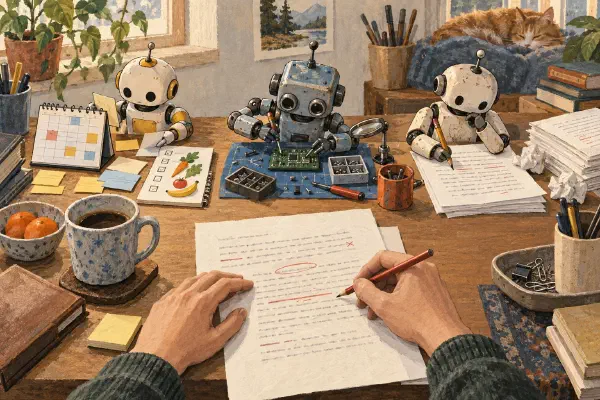
When I use it to write a substantial document, I start by deciding what I am trying to say. I define the structure, provide the relevant context and explain the goal. Then I generate a section, edit it myself, challenge it, add missing context and repeat.
The same applies to code. An agent can produce an implementation quickly, but I still need to decide whether the feature should exist, whether the approach belongs in the system and whether the result is maintainable. Passing tests answer only part of that.
Whether AI or a person wrote something tells me little. What matters is whether it is disposable output or considered work, and disposable output is where most of the noise comes from.
AI can participate in considered work. It can question, draft, compare and revise at a speed I cannot match. But the value comes from the loop: structure, context, generation, review, manual edits and another pass. My brainpower goes into the parts that are not clockwork.
Send less to people#
There is an obvious trap in using AI to summarize all the material that AI helped us create. Better filtering can make the volume survivable without questioning why the volume exists.
Total output can keep growing. What has to shrink is the share of it aimed at people. Not every update needs to be sent. Not every idea needs a document. Not every working piece of code needs to become a feature. Before asking AI to summarize an artifact, it is worth asking whether the artifact needed to exist.
The producer should carry some of the cost of consumption. Anything handed to another person, by a person or by an agent, should say what changed, why it matters and what decision is required. If I cannot answer those three questions, the artifact is probably not ready to send, and it may not need to exist. My agents now work under the same rule: routine monitoring stays quiet when there is nothing actionable. Sometimes the correct update is silence.
Teams adopted the tools and kept the process#
Most of how product teams work was designed when producing things was expensive. A spec took a week to write, so few specs arrived for review. A prototype took a sprint, so people argued about whether to build it first. The cost acted as a rate limit, and the process depended on it.
That limit is gone. Everyone can generate a document and everyone can generate code, but the review meeting, the approval chain and the number of people who can make the call are the same as before. We adopted the tools and kept the organization.
I do not have the new structure figured out. I think it starts with treating the attention of the people who decide as the budget everything else is planned around: fewer artifacts aimed at people, smaller groups making decisions, and a clear answer to who needs to see what.
Attention is now the hard limit. The teams that do well will be the ones that protect enough judgment to find the value inside the volume.
None of this is an argument for or against AI. I use it every day to think, create and get through the noise. But the decisions that matter are still made by people talking to each other, with finite attention and judgment that takes time. I want these tools to clear room for that conversation, so that we are present for the parts that matter.